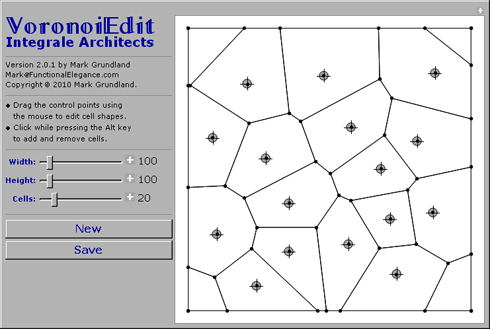
Voronoi diagram editor with DXF export to AutoCAD
Web: www.FunctionalElegance.com
Email: Mark@FunctionalElegance.com
Computational
Geometry Tools for Decorative Architectural Design
for Sheldon Bakos at Integrale Architects, Johannesburg, South
Africa (2010)
Voronoi diagram editor with DXF export to AutoCAD
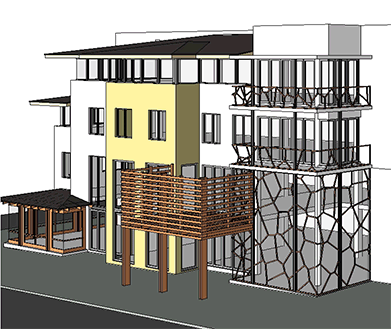
Architectural sketch with Voronoi shaped windows, by Sheldon Bakos
Automated Non-photorealistic
Rendering for Image Compression
supervised by Dr.
Neil Dodgson at the Rainbow
Group of the Computer Laboratory,
University of Cambridge (2001)
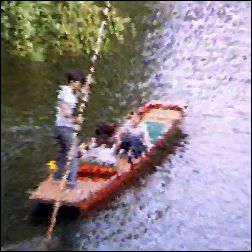
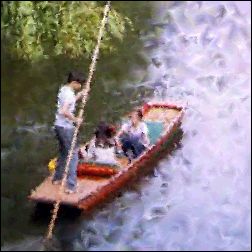
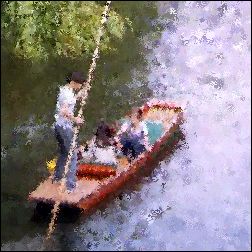
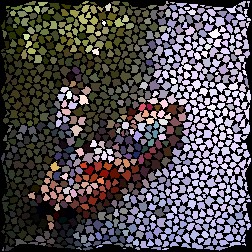
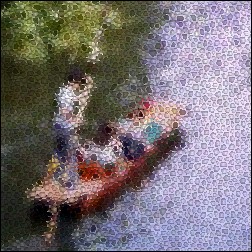
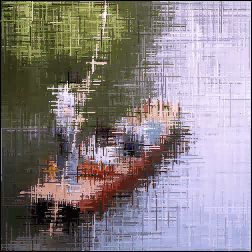
Summary: For use in progressive image compression, these techniques generate a wide variety of image rendering styles, ranging from a hand-painted look to an inlay mosaic, by applying geometric subdivision as well as parametric procedural textures to Voronoi spatial partitions. This approach of image reconstruction from scattered color samples provides for an efficient multiresolution image representation.
Seminar: Automated Artistic Image Rendering
Paper: Stylized Rendering For Multiresolution Image Representation
Play: Progressive Image Rendering QuickTime Movies: "Adaptive Voronoi Diagram", "Lighthouse", "Autumn", and "Lena"
 |
 |
 |
|---|---|---|
 |
 |
 |
Computer Visualization
of Quasicrystals
for Dr.
Jiri Patera at the Centre
de Recherches Mathématiques, Université
de Montréal (2000)
Seminar: Generating Aperiodic Tilings Using Quasicrystals
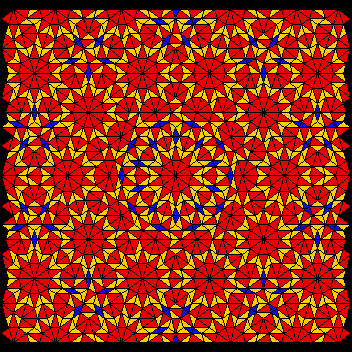
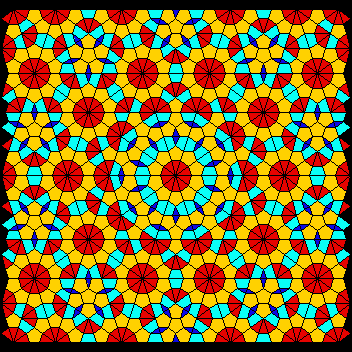
Delaunay triangulation and Delaunay graph of the quasicrystal
point set defined by the H2 Coxeter Group.
Genetic Algorithms
for Geometric Primitive Detection
with Youenn Fablet for the Pattern
Recognition Course at the School
of Computer Science, McGill
University (1999)
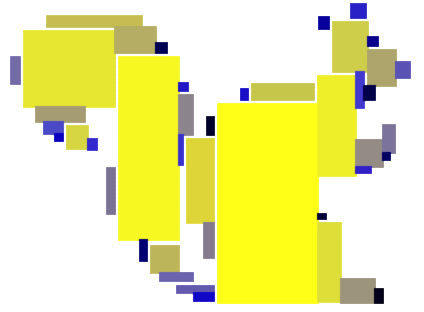
Visualization in Number
Theory
for the Number
Theory Course at the Department
of Mathematics and Statistics, McGill
University (1999)
Source: Luc Devroye's Random Trees
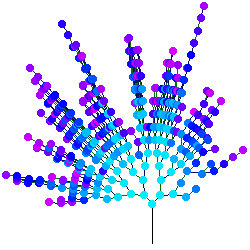

Binary tree of a sequence of random numbers.
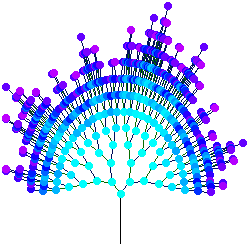

Binary tree of the sequence of fractional parts of n*Sqrt(2).
VoronoImage: A Virtual
Stained Glass Workshop
with for the Computational
Geometry Course at the School
of Computer Science, McGill
University (1998)
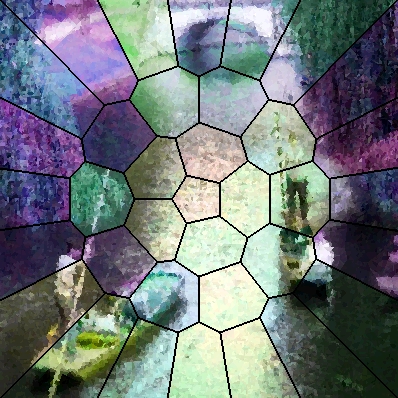
Summary: VoronoImage is a program for the Macintosh which demonstrates an application of computational geometry to rendering a picture into an image resembling a stained glass panel. The technique works through generating a partition tree representing a fractal arrangement of discreet Voronoi diagrams, where each Voronoi polygon is recursively subdivided into a Voronoi diagram. The Voronoi diagrams are calculated using a fast Euclidean distance mapping algorithm.
Visual Simulation of
Fire
with Andrew Sacamano for the Computer
Graphics Course at the School
of Computer Science, McGill
University (1997)
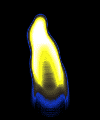
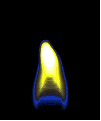
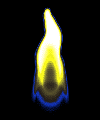
Real-time candle flame animation running on a 25MHz Mac.
Image Processing for the Imagination

Copyright © 2015 Mark Grundland. All rights reserved.